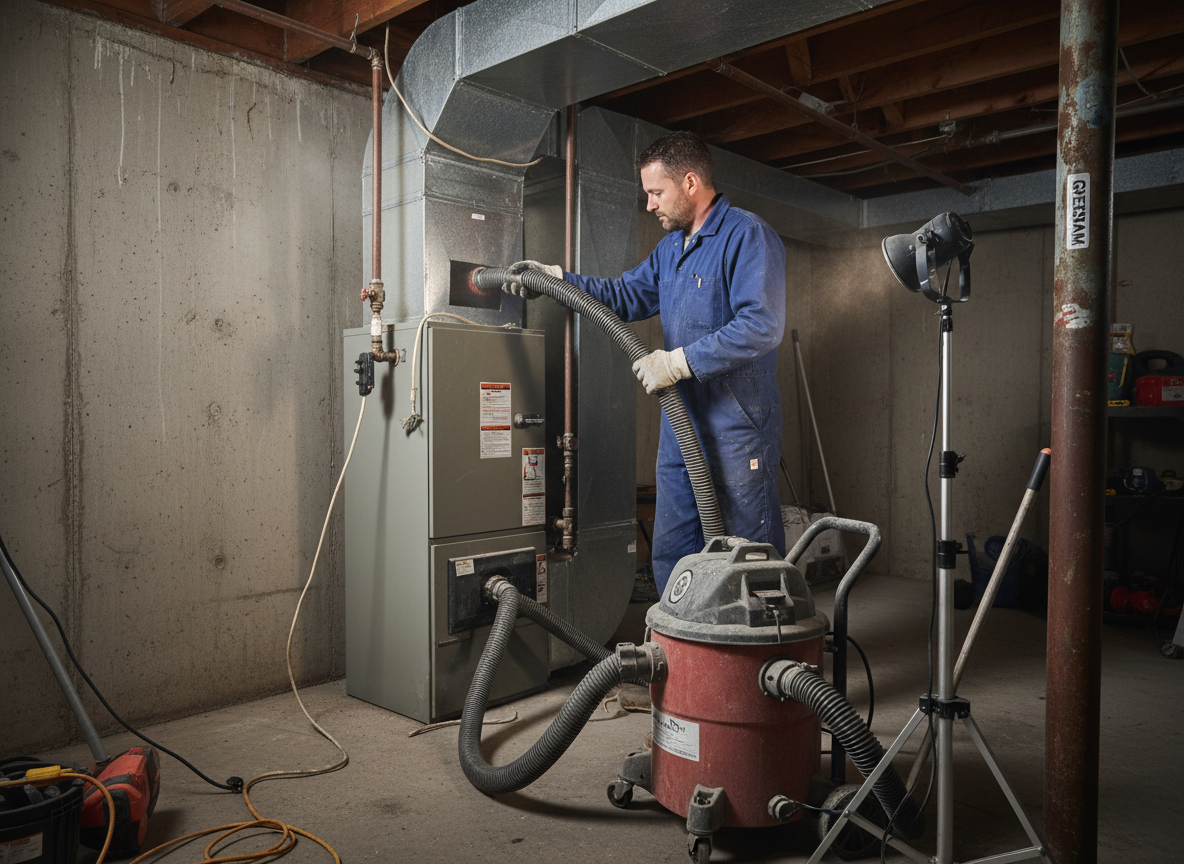
Gresham homes built before the 1980s in Rockwood and near the Gresham Pioneer Cemetery often have rigid metal duct runs that collect fine silt from the surrounding terrain. Wet winters bring repeated humidity spikes and occasional floodwater intrusion into crawlspaces, which pushes moisture into the return lines and encourages dust adhesion inside the furnace cabinet. Mild summers do little to dry these systems out, so by late fall the blower motor works harder against restricted airflow. Technicians start every job by mapping the full trunk and branch layout from the attic or crawlspace access points rather than assuming standard configurations common in newer Portland subdivisions.
Furnace and duct cleaning here requires removing the blower assembly on many mid-century units because the evaporator coil sits directly above the heat exchanger, trapping debris that standard vacuum wands miss. In Multnomah County properties close to Mt. Hood Community College, pollen from the surrounding green spaces adds a sticky layer that binds with construction dust left from original builds. Crews use negative-air machines rated for the full system volume and finish with a camera inspection to confirm no insulation fragments remain in the supply runs. Skipping the furnace interior leaves the source of recontamination untouched, especially after the first heavy rain of the season.
Homeowners in Downtown Gresham frequently report uneven heating on the second floor because return ducts routed through unconditioned spaces pull in moist air during winter storms. Cleaning must include sealing accessible joints with mastic rather than relying solely on tape, which fails quickly in the humidity. The work also covers the condensate drain line on high-efficiency units to prevent backup that forces water into the ductwork. This approach prevents repeat service calls that would otherwise occur every other winter when the system is under heaviest load.
Technician insight
In Gresham, the thing that catches most people out with furnace and duct cleaning is how wet winters push moisture into crawlspace returns on 1960s-1970s homes in Rockwood. Homeowners often clean only the visible vents, leaving the furnace cabinet full of silt that the next storm re-circulates. The fix starts with pulling the blower on every job.
Rockwood Crawlspace Moisture
A 1972 split-level near Rockwood had weak airflow after the first winter rains. Inspection showed standing water residue in the return trunk that had pulled fine silt into the furnace. The crew removed the blower, cleaned the full duct runs under negative air, sealed joints, and verified clearance with the camera. Heating balanced across both floors and no further moisture odor returned.
How it works
- 1
System Mapping
Locate all trunk lines, returns, and furnace access points in the specific layout of Gresham homes, noting crawlspace or attic entry points affected by local terrain.
- 2
Negative Air Setup
Connect HEPA-filtered equipment to create containment and prevent redistribution of debris into living spaces during wet-weather jobs.
- 3
Mechanical Agitation
Use brushes sized for rigid metal ducts common in older Rockwood properties, followed by removal of blower and coil sections.
- 4
Final Verification
Run camera inspection and test airflow before restoring power, confirming moisture-sensitive areas near flood zones are clear.
Pricing
Upfront quotes based on system size, access difficulty, and condition; no hidden add-ons after inspection.