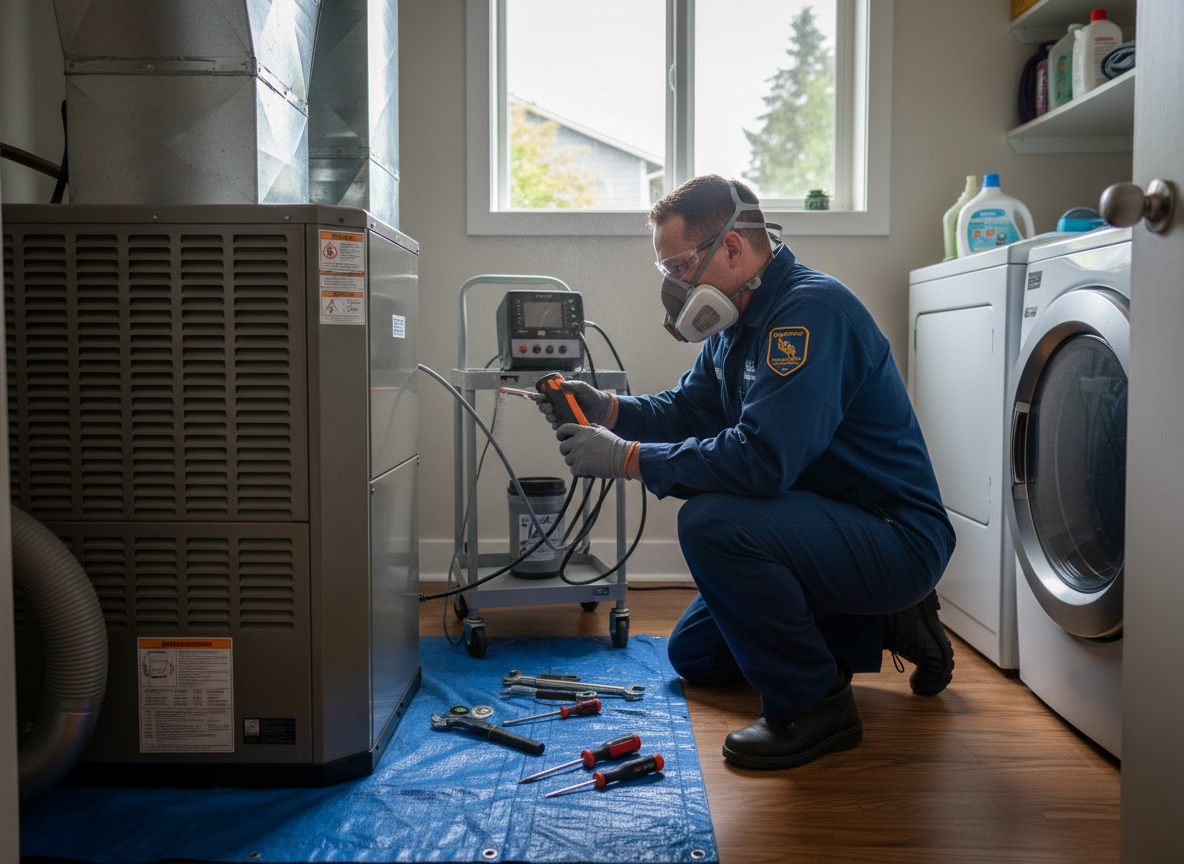
Gresham homes in neighborhoods like Rockwood and Downtown often feature duct systems installed decades ago in single-story ranches and split-levels common throughout Multnomah County. Wet winters bring repeated moisture intrusion through vents and crawlspaces, especially when occasional flooding saturates soil around foundations near Gresham Pioneer Cemetery. This leads to dust cakes mixed with pollen that mild summers never fully dry out, allowing spores to circulate. Technicians must account for these cycles when accessing trunk lines that run through unconditioned attics where temperature swings accelerate condensation.
Near Mt. Hood Community College, many properties sit on lots with poor drainage that channels winter runoff directly under floor registers. Air duct cleaning here requires isolating sections to prevent cross-contamination between living spaces and utility areas, then addressing the fine silt that settles in low-velocity return ducts. Portland commuters add another layer because vehicle exhaust infiltrates through unsealed exterior penetrations during the long rainy season. Proper sequencing prevents pushing contaminants deeper into branch lines that serve bedrooms.
Operators working 24/7 from the Burnside Road location know that post-flood inspections frequently reveal standing water residue inside flex duct runs that standard vacuum methods miss. In these cases, targeted agitation followed by HEPA filtration becomes necessary before any antimicrobial treatment. Homeowners in older Multnomah County stock also face the added challenge of asbestos-wrapped duct tape from the 1970s that can degrade during service and require careful containment to avoid fiber release into living areas.
Technician insight
In Gresham, the thing that catches most people out with indoor air quality services is how wet winters push silt into crawlspace ducts in Rockwood homes built before the 1980s. Those properties near the cemetery often have return lines that stay damp through mild summers, so standard cleaning leaves residue that reactivates with the next rain event.
Downtown Gresham Duct Moisture Issue
A homeowner near Downtown reported ongoing musty odors after winter rains. Inspection revealed silt residue in return ducts tied to poor drainage around the foundation. Crew isolated the lines, performed mechanical agitation under negative pressure, and extracted the accumulated material. Odors cleared and airflow improved without further moisture reactivation during the following wet season.
How it works
- 1
Initial Assessment
Technicians arrive at the Gresham address and map all supply and return runs while noting moisture stains from winter flooding common in Rockwood.
- 2
Negative Pressure Setup
Equipment isolates sections of ductwork to contain debris before agitation begins on lines serving homes near Mt. Hood Community College.
- 3
Mechanical Cleaning
Rotary brushes and compressed air remove compacted dust and silt accumulated during wet seasons in Multnomah County housing.
- 4
Final Filtration and Verification
HEPA units capture remaining particles and registers are inspected before the system is returned to normal operation.
Pricing
Cost depends on home size, number of runs, and extent of moisture-related buildup; quotes provided after inspection.